
CONSTRUCTION
Construction workflow automation
for UK contractors and developers
Strategy before software. Honesty before hype.
Severus is a business automation and operations partner working with UK main contractors, MEP and fit-out subcontractors and property developers. We map how work actually moves between site and office, cost the admin leak in money rather than adjectives, and integrate the systems you already run — Procore, COINS, Sage, Asta — before anyone writes a line of code.
CASE STUDIES
Results, Not Promises
Three UK contractors. Three different leaks. One
order of work: fix the definitions, then automate.
Live P&L and Cost Control for a Construction Firm
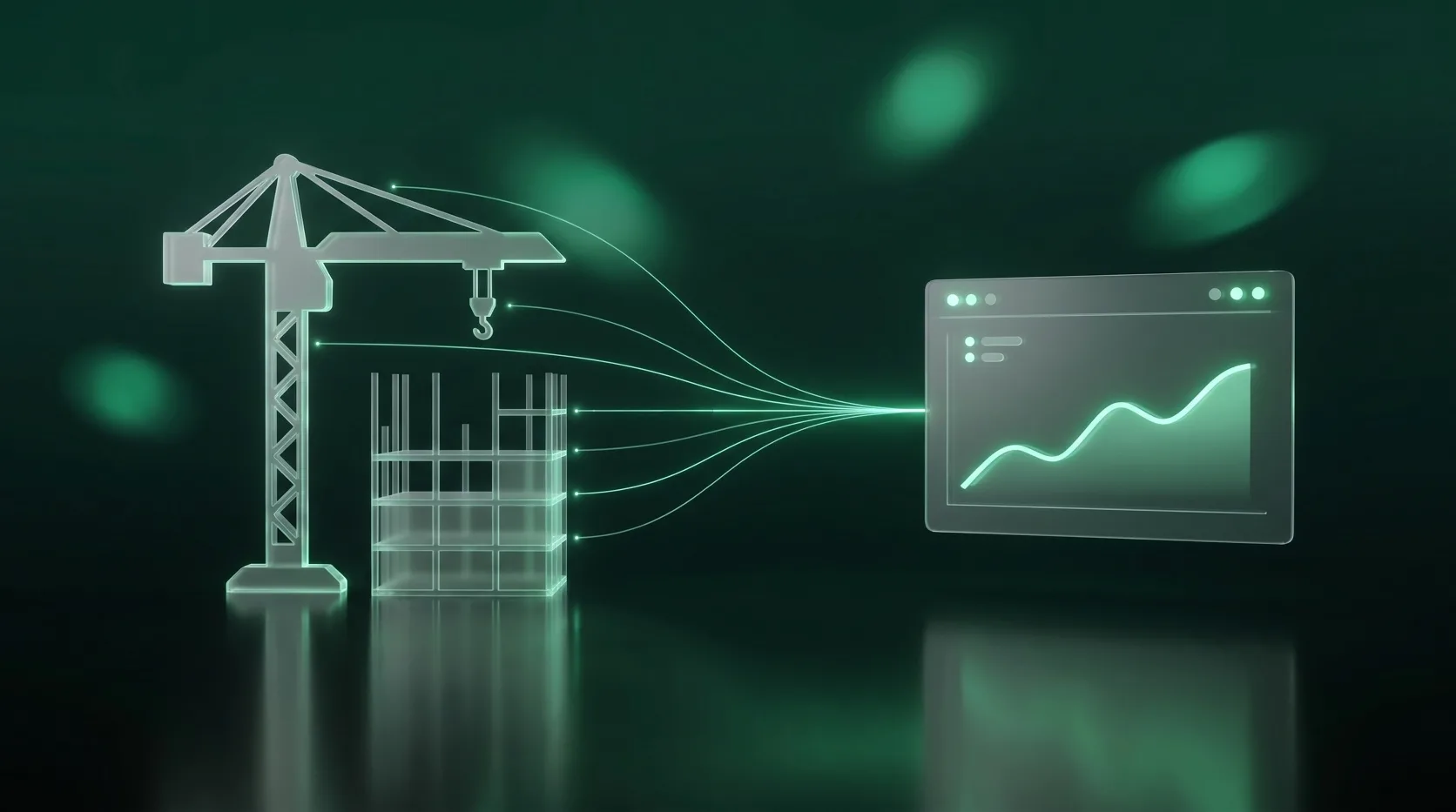
One connected system for costs, variations, timesheets and month-end close. Cost leakage fell by 68%, claimed variations rose by 340%, and the firm reached its return on investment in seven months against a twelve-month goal.

Property Developer Process Automation
Property developer process automation gave a construction team and an in-house legal team one shared view of commercial risk — for the first time in the business's history. Two experienced functions had run in parallel for years, connected only by email. Severus agreed the definitions first, then integrated the systems.

PropTech Onboarding Automation: 23 Days to 8
A post-seed PropTech startup cut time-to-value from 23 days to 8 by standardising onboarding before automating it — then doubled customers with no new hires
Construction workflow automation for UK contractors
Construction workflow automation is not a software purchase. It is a decision about how your business should run in a year’s time, and then the work of getting it there. For a UK main contractor, MEP or fit-out subcontractor or property developer, that usually means the same few things: the true margin on every live job visible without a week of spreadsheets, commercial decisions made in hours rather than days, and more projects carried by the same office team.
Severus defines the outcome your business needs, designs the best route to it with the risks mapped upfront, and takes full responsibility for implementing the software that gets you there. We work with UK contractors and developers who already run Procore, COINS, Sage, Asta, Excel and email, and who want those tools to add up to one clear picture of the business.
Start from the outcome, not the software
Most construction technology projects start with a demo. A platform looks good, the contract is signed, and twelve months later site teams are back on spreadsheets because nobody agreed what the system was meant to change. The issue was rarely the software. It was the missing definition of the result.
We start one step earlier. Before anyone chooses a tool, we agree with you what should be different in three, six and twelve months, where in the business it should show up, and which numbers will prove it. Typical examples from contractors:
- project margin held from tender to final account, not discovered at the end;
- 15 to 20 per cent more work run by the same commercial and site teams;
- one reliable view across every live project for the board, updated weekly rather than monthly;
- a shorter path from work done on site to valuation, approval and cash;
- contract risk found and priced before signature, not argued about on site.
Once the outcome is clear, the right route is usually obvious, and it is often smaller and cheaper than the platform that was on the shortlist.
How we work: three stages, each with a clear output
1. Clarity Sprint (two to three weeks). A small Severus team works through your commercial, operational and admin processes with you, founder to founder, as if it were our own business. The output is a clearly defined point B: what must change, where, by when, and which KPIs will show it.
2. Solution Design Sprint. We look at how the business runs today and design several routes to point B. Each option comes with its cost, timeline, what it needs from your team, the best-fit technology and the risks, including the risk of staying with your current systems. You pay for design once so that you do not overpay many times over in implementation.
3. Implementation. We choose the option together, and Severus implements it exactly as agreed, with a fixed price and timeline set after the design stage. We manage the whole process on our side and take full responsibility for delivery. If you need ongoing support afterwards, we stay on.
Construction business automation: where contractors usually start
Every contractor is different, but the first outcome usually sits in one of four places.
Commercial reporting and cost control
Cost-to-complete, valuations, variations and forecasts often live in separate spreadsheets that someone reconciles by hand at month end. Construction reporting automation pulls those figures from the systems you already use into one agreed view, so the commercial team spends its time on decisions rather than on copying numbers.
Site to office handover
Daily diaries, labour returns, snagging and RFIs are captured on site and then retyped in the office. Defining one way of capturing each item once, and passing it on automatically, removes a large share of office admin without changing how site teams work.
Contracts and risk
JCT, NEC and FIDIC contracts carry risk that is cheap to price at the desk and expensive to dispute on site. Contract review with lawyer verification, supported by AI where it helps, can find those clauses before signature. Read more in AI contract review for UK construction.
Framework and bid administration
Public frameworks bring a steady flow of smaller schemes, each with its own documentation and reporting. Standardising that work, from award to start on site, lets the same team carry more framework projects.
Construction systems integration: Procore, COINS, Sage and Asta working together
Most UK contractors do not need another platform. They need the ones they already pay for to share data. When Procore does not talk to Sage, or COINS does not reflect what the programme in Asta says, people become the integration layer: exporting, reformatting and re-entering the same figures.
Construction systems integration connects those tools around an agreed set of definitions, such as what counts as committed cost, when a variation is approved and which system is the source of truth for each figure. We define those rules first and integrate second. Integrating first only moves the confusion faster. Our guide to Procore and Sage integration walks through how this works in practice.
AI for construction companies: where it pays and where it does not
AI in construction works well in a few specific areas: reading and comparing contract documents, extracting data from invoices and delivery notes, and searching a company’s own project history. It works poorly when the underlying data is inconsistent or when nobody has agreed what decision the AI is meant to support.
We use AI heavily in our own work, and we implement it for clients when the outcome needs it. When it does not, we say so. The question is always the same: what result should this produce for the business, and how will we measure it? Our article on AI in construction covers what UK contractors get right and where most pilots stall.
Who we work with
- Main contractors who want a reliable view of margin and programme across every live project.
- MEP and fit-out subcontractors carrying many jobs at once, where admin per project eats the margin.
- Property developers who need construction, commercial and legal teams working from one picture of risk.
- Growing regional contractors winning framework places and planning to grow turnover without growing the office at the same rate.
What changed for contractors we have worked with
We keep client names private, and you would get exactly the same courtesy. What we can share is what changed:
- Construction systems integration for a fit-out contractor: month-end reconciliation between COINS and Procore, after the site data was standardised first.
- Construction reporting automation for a main contractor: one agreed set of commercial figures instead of several competing ones.
- AI contract review for an MEP subcontractor: contract risk found before signature rather than on site.
- Process automation for a property developer: construction and legal teams sharing one view of commercial risk.
With Centrus360 we went from idea to a working product in nine months. Its founder came to us as a client and then asked us to become co-founders, because we were treating his business as our own. That is how we approach every contractor we work with.
Further reading for UK contractors
- How to digitise a construction business without breaking what already works
- Construction software that site teams actually keep using
- AI in construction: what UK contractors get right
- AI contract review for UK construction
- Procore and Sage integration in practice
- Build, buy, integrate or automate: how to decide
Construction workflow automation questions we get asked
What is construction workflow automation?
It is the work of making information move through a construction business without people retyping it: from site to office, from commercial systems to the board, from contract to programme. Done well, it starts by agreeing the outcome and the definitions, and only then connects or builds the software.
Do we need to replace Procore, COINS or Sage?
Usually not. Most contractors get more from integrating the systems they already have than from replacing them. The Solution Design Sprint compares replacing, integrating and automating side by side, with the cost and risk of each.
How long does it take to see a result?
The Clarity Sprint takes two to three weeks and ends with an agreed outcome and KPIs. Implementation timelines are fixed after the design stage, once the route is chosen.
Is this an AI project?
Only if the outcome needs AI. Many of the biggest gains in construction come from agreeing definitions and connecting existing systems. Where AI helps, for example in contract review or document extraction, we implement it as part of the same plan.

Get everything you need to start development
Make informed decisions to optimize your products, services, and projects in the context of your market, and add value by looking at the wider business picture.
Get Started