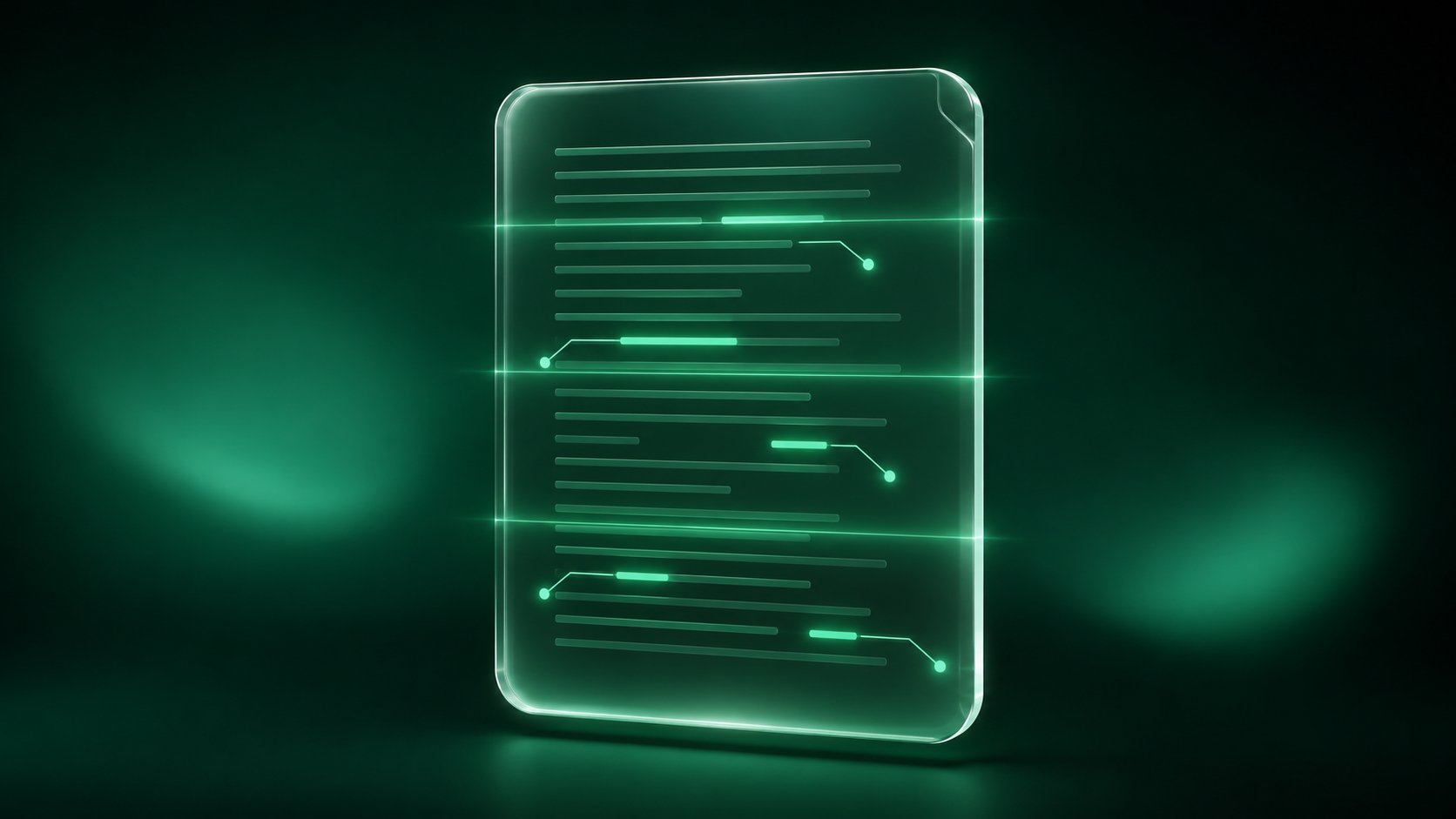
AI contract review tools can flag risk clauses and identify compensation event triggers. They also cross-reference standard terms in NEC and JCT contracts significantly faster than manual review. For UK contractors running multiple concurrent projects, this ranks among the most immediately practical applications of AI in construction. That holds true only when you have properly digitised the contracts and clearly defined the review process first.
Why AI contract review is one of the best starting points for AI in construction
Commercial risk is where UK contractors make and lose the most money. A missed early warning notice under NEC, a poorly understood payment mechanism, an ambiguous scope definition that creates a variation dispute six months into a project — these are the situations that turn a profitable job into a loss-making one.
Manual contract review is slow, inconsistent, and dependent on whoever is doing it. A senior commercial manager reviewing a 300-page NEC4 contract will catch things a junior QS misses. An AI tool, used correctly, provides a consistent baseline review that catches the clauses worth escalating for human judgement — every time, regardless of who is available and how stretched the team is.
That is the value. Not replacing commercial expertise, but making sure nothing obvious slips through when the team is under pressure.
What AI contract review actually does in a construction context
Clause identification and flagging. AI tools trained on construction contracts can identify specific clause types — early warning obligations, compensation events, time bar provisions, liquidated damages caps, fitness for purpose obligations — and flag them for review. This is reliable and fast. A review that might take a commercial manager two hours finishes in minutes. The structured output tells the team exactly where to focus attention.
Risk scoring. Some tools go further and score clauses by risk level, giving commercial teams a prioritised reading list rather than a full document review. The quality of this scoring varies, however. Much depends on how well the vendor trained the AI on construction-specific contracts and UK legal frameworks. Not all vendors have done that work.
Cross-referencing against standard terms. Where a contractor has a standard set of preferred terms or a risk register, AI can compare the contract under review against those benchmarks and flag deviations. This is particularly useful for contractors working across multiple clients with different standard forms.
Variation and amendment tracking. On long-running projects with multiple contract amendments, AI can track changes across versions and maintain a current summary of the commercial position. For framework agreements with multiple call-off contracts, moreover, this becomes genuinely significant.
Correspondence and notice tracking. Beyond the contract itself, some tools extend into the correspondence layer. They track RFIs, early warnings, and payment notices, so the team meets every time-bar obligation. Nothing then slips through the day-to-day commercial administration of a project.
What AI contract review cannot do
This matters, because vendors do not always make it clear.
It cannot exercise commercial judgement. AI can flag that a clause is high-risk. It cannot tell you whether to accept it, negotiate around it, or walk away from the project. That decision requires understanding the client relationship, the competitive context, the programme pressures, and the wider portfolio — none of which the tool has access to.
It cannot replace experienced QS input on complex disputes. When a dispute is already live, or when the commercial position is genuinely ambiguous, AI is a research assistant at best. The legal and commercial strategy still requires human expertise. The same boundary applies on the legal side of the same problem, where legal document automation accelerates drafting and review but never signs off on the position.
It cannot work reliably on scanned PDFs or poorly formatted documents. AI contract review requires contracts to be in a format the tool can parse. Handwritten amendments, scanned documents with poor OCR, or contracts stored inconsistently will produce unreliable results. Therefore, before implementing any AI contract review tool, you need to know what format your contracts actually exist in.
It is only as good as its training data. A tool trained primarily on US contracts will miss UK-specific obligations. A tool trained on standard JCT but not on bespoke client amendments gives you a false sense of security. Always ask which contracts the vendor used for training, and whether they cover the specific contract forms you use.
What to check before buying an AI contract review tool
Your contract library. Are your contracts stored digitally in a consistent, searchable format? If you are working from scanned PDFs or contracts spread across email threads and shared drives, the tool will not work reliably. Technical implementation needs to start with the library, not the software — which is the same sequencing problem covered in how to digitise a construction business.
Your review process. Who currently reviews contracts in your business, at what stage, and against what criteria? AI works best when it supports a defined process — it is a poor substitute for one. If your contract review is ad hoc, therefore, you need to design the process before you digitise it.
The vendor’s construction experience. Have they worked specifically with UK construction contracts? Can they show you examples of NEC and JCT review outputs? Do they understand the difference between a compensation event and a variation? Or do they simply apply generic legal AI terminology to contract forms their tool has never seen?
Integration with your existing systems. Where do your contracts live? Where do the outputs need to go? A tool that produces a PDF risk report but does not connect to your commercial management system creates a new manual step rather than eliminating one. Consequently, this is where a lot of otherwise sound purchases quietly die — see why contractors keep buying construction software that doesn’t stick.
The support model post-implementation. Contract review tools need to stay current as contract forms evolve. How does the vendor handle updates to NEC or JCT? What happens when a client uses a heavily amended bespoke form the tool has not encountered before?
How to run a proper AI contract review pilot
Do not let the vendor choose the pilot contract. First, give them your most complex, most heavily amended contract from the last two years — the one where something went wrong commercially — and ask the tool to review it. Then compare the output against what your team actually knew about that contract at the time.
This tells you two things: whether the tool would have caught the issues that mattered, and whether it generates enough false flags that the team will start ignoring it. Both outcomes are useful. The first validates the tool. The second, by contrast, is a sign to look elsewhere or adjust the configuration before committing.
What AI contract review looks like when it works
A subcontractor specialising in MEP work on commercial fit-out projects was reviewing framework call-off contracts manually for each new instruction. The process took a senior QS roughly half a day per contract, and it ran inconsistently. The QS caught and negotiated some risk clauses, but missed others.
After implementing an AI contract review layer trained on JCT and the client’s bespoke amendments, the same QS received a flagged risk summary in under ten minutes. As a result, the half-day review became a thirty-minute check of flagged items. Consistency improved significantly across what the QS caught and escalated.
The tool did not replace the QS. It made the QS more effective on every single contract, rather than only on the ones where they had enough time to read carefully.
Read the full story: AI contract review for an MEP subcontractor.
Frequently Asked Questions
Yes. Several vendors train their tools on NEC3 and NEC4 forms. Those tools reliably identify compensation event triggers, early warning obligations, and time-bar provisions. Quality varies between vendors. Always verify with a test on real contracts before committing.
Pricing varies widely — from a few hundred pounds per month for smaller firms to enterprise arrangements for large contractors reviewing hundreds of contracts annually. The more relevant question, however, concerns the cost relative to the commercial risk a missed clause represents. On a typical NEC contract, that risk dwarfs the software cost.
For a standard NEC or JCT contract, initial review time typically drops by 50 to 70 percent. The commercial manager still needs to review the flagged clauses. That time now goes to the issues that matter, rather than to reading every page.
It is a risk identification tool, not a legal opinion. The output tells your team what to look at closely. It does not constitute legal advice. Never treat it as a substitute for legal advice on complex or high-value contracts.
The market is developing quickly. Kira, Luminance, and several construction-specific platforms are building contract intelligence into their products. The right tool depends on your contract volume, complexity, and existing systems. No single answer works for every contractor — which is precisely why the evaluation process matters.
Let’s discuss your optimisation roadmap.